Lightning Protection
Original manual page 70
This section reproduces ABYC Standard E-4, Lightning Protection (12/96), as included in the Catalina 310 owner's manual. "ABYC" is the American Boat and Yacht Council; the standard is © 1996 American Boat & Yacht Council, Inc. Section numbers are as printed (4.1, 4.2, ...). Check the current ABYC standard for up-to-date requirements.
Based on ABYC's assessment of the existing technology, and the problems associated with achieving the goals of this standard, ABYC recommends compliance with this standard for all systems and associated equipment manufactured and/or installed after July 31, 1998.
E-4 Lightning Protection
4.1 Purpose
These standards and recommended practices are guides for the design, construction, and installation of lightning protection systems on boats.
NOTE: The probability of a lightning strike varies with geographic location and the time of the year, but, when the conditions that create an electrical charge between clouds and the earth exist, there is nothing that can be done to prevent the lightning discharge. A boat can be struck in open water or while tied to the dock.
4.2 Scope
These standards and recommended practices apply to powerboats and sailboats if a lightning protection system is installed.
NOTES:
- Complete protection from equipment damage or personal injury is not implied.
- A lightning protection system offers no protection when the boat is out of water, and is not intended to afford protection if any part of the boat comes in contact with power lines while afloat or ashore.
- Protection of persons and small craft from lightning is dependent on a combination of design and maintenance of equipment, and on personnel behavior.
The basic guides contained in this standard shall be considered and used in designing and installing a lightning protection system. However, in view of the wide variation in structural design of boats, and the unpredictable nature of lightning, specific recommendations cannot be made to cover all cases.
4.3 Referenced Organizations
ABYC - American Boat and Yacht Council, 3069 Solomon's Island Road, Edgewater, MD 21037-1416. 410-956-1050.
NFPA - National Fire Protection Association, 1 Batterymarch Park, PO Box 9101, Quincy, MA 02269-9101. 617-770-3000.
4.4 Definitions
- Air terminal
- A device at the uppermost point of the lightning protection system to dissipate the charge or start the lightning ground process.
- Equalization bus
- A metallic strap, which may be installed on the interior of a boat, substantially parallel to the exterior lightning ground plate, and connected to the lightning ground plate at both ends. Secondary lightning conductors can be connected to the equalization bus. The equalization bus provides a low resistance path to the lightning ground plate.
- Lightning bonding conductor
- A conductor intended to be used for potential equalization between metal bodies, and the lightning protection system to eliminate the potential for side flashes.
- Lightning ground plate (or strip)
- A metallic plate, or strip on the hull exterior below the waterline, that serves to efficiently transfer the lightning current from the system of down conductors to the water.
- Lightning protective gap (air gap)
- A form of lightning arrester wherein a small air space is provided between two metallic plates, with one connected directly to the vessel grounding plate or strip, and the other to an operating electrical system, such as a radio transmitter or receiver.
- Lightning protective mast
- A conductive structure, or if non-conductive, equipped with a conductive means, and an air terminal.
- Parallel path
- A path to ground that may be followed by a lightning strike. This path is separate from the path formed by the primary lightning conductor.
- Primary lightning conductor
- The main vertical electrical path in a lightning protection system formed by a metallic mast, metallic structure, electrical conductors, or other conducting means, to a ground plate, ground strip, or a metallic hull.
- Secondary lightning conductor
- A conductor used to connect potential parallel paths, such as the rigging on a sailboat, to the primary lightning conductor, or to the lightning ground plate, strip or equalization bus.
- Side flash
- An arc-over discharge that occurs from the lightning system to any metallic object.
- Zone of protection
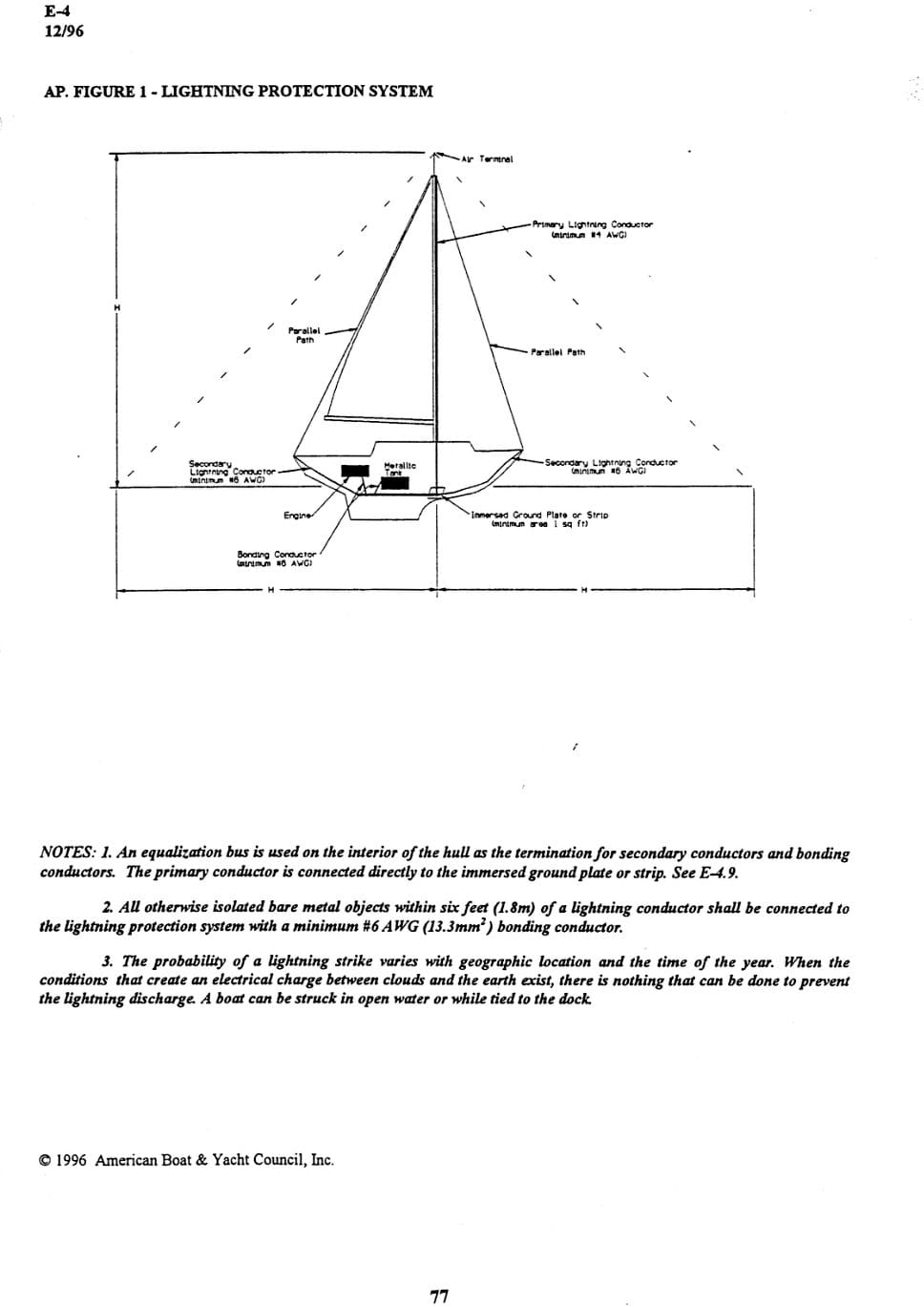
- An essentially cone shaped space below a grounded air terminal, mast, or overhead ground wire, wherein the risk of a direct lightning strike is substantially reduced. See Appendix 1.
4.5 Requirements - In General
4.5.1 To provide a conductive path for the adequate discharge of lightning currents, from the air terminal at the top of a lightning mast to the water (ground), the system shall
- 4.5.1.1 be essentially vertical, and
- 4.5.1.2 be essentially straight, and
- 4.5.1.3 have a conductivity not less than that of a #4 AWG (21.2mm2) copper conductor, and
- 4.5.1.3.1 where the system consists of multiple shrouds, stays and mast, they shall have an aggregate conductivity not less than a #4 AWG (21.2mm2) copper conductor.
4.5.2 Every metallic shroud and stay shall be connected from the chain plate directly to the ground plate or ground strip with a conductor at least #6 AWG (13.3mm2).
4.5.3 No bend of a conductor shall form an included angle of less than 90°, nor
- 4.5.3.1 shall it have a radius of bend less than eight inches (203mm).
4.5.4 Large metal objects such as tanks, engines, deck winches, stoves, etc., within six feet (1.8m) of any lightning conductor shall be interconnected by means of a lightning bonding conductor at least equal to #6 AWG (13.3mm2) copper.
NOTES:
- To minimize flow of lightning discharge current through engine bearings, it may be preferable to bond engine blocks directly to the ground plate rather than to an intermediate point on the lightning protection system.
- Large metal bodies on boats include any large masses such as bow and stern pulpits, steering pedestals, horizontal guardrails, handrails on cabin tops, smokestacks from galley stoves, electric winches, davits, metallic hatches, metallic arches, towers, engines, water and fuel tanks, and control rods for steering gear or reversing gear.
- It is not intended that small metal objects such as compasses, clocks, galley stoves, medicine chests, and other parts of the boat's hardware be grounded.
- For illustration purposes see Appendix, Figure 1.
4.6 Requirements - Materials
4.6.1 Corrosion - The material used in a lightning protective system shall be resistant to corrosion.
NOTE: Where it is necessary to join dissimilar metals, the corrosion effects can be reduced by the use of suitable plating or by installing a metal fitting between the two dissimilar metals that is galvanically compatible with both metals.
4.6.2 Wire Conductors
- 4.6.2.1 Wire conductors shall be stranded copper.
- 4.6.2.2 Stranding of copper wire shall be Type II stranding in accordance with ABYC E-8, AC Electrical Systems on Boats, and/or ABYC E-9, DC Electrical Systems under 50 Volts.
4.6.3 Other Conductive Means
- 4.6.3.1 Conductivity shall be equal to, or greater than, #6 AWG (13.3mm2) copper wire.
- 4.6.3.2 The thickness of metal ribbon or strip shall be at least 1/32 inch (0.8mm).
- 4.6.3.3 Copper braid shall not be used.
4.7 Requirements - Installations
4.7.1 To minimize side flashes, and the induction of high voltage to the boat's wiring, lightning conductors in proximity to the boat's wiring shall not be routed in parallel to the boat's wiring. EXCEPTION: The primary lightning conductor.
4.7.2 Conductive Joints - Conductive joints shall be made and supported in accordance with ABYC E-9, DC Electrical Systems Under 50 Volts, and
- 4.7.2.1 shall have an electrical resistance not in excess of that of two feet (0.6m) of the smaller diameter conductor.
4.8 Lightning Protective Mast
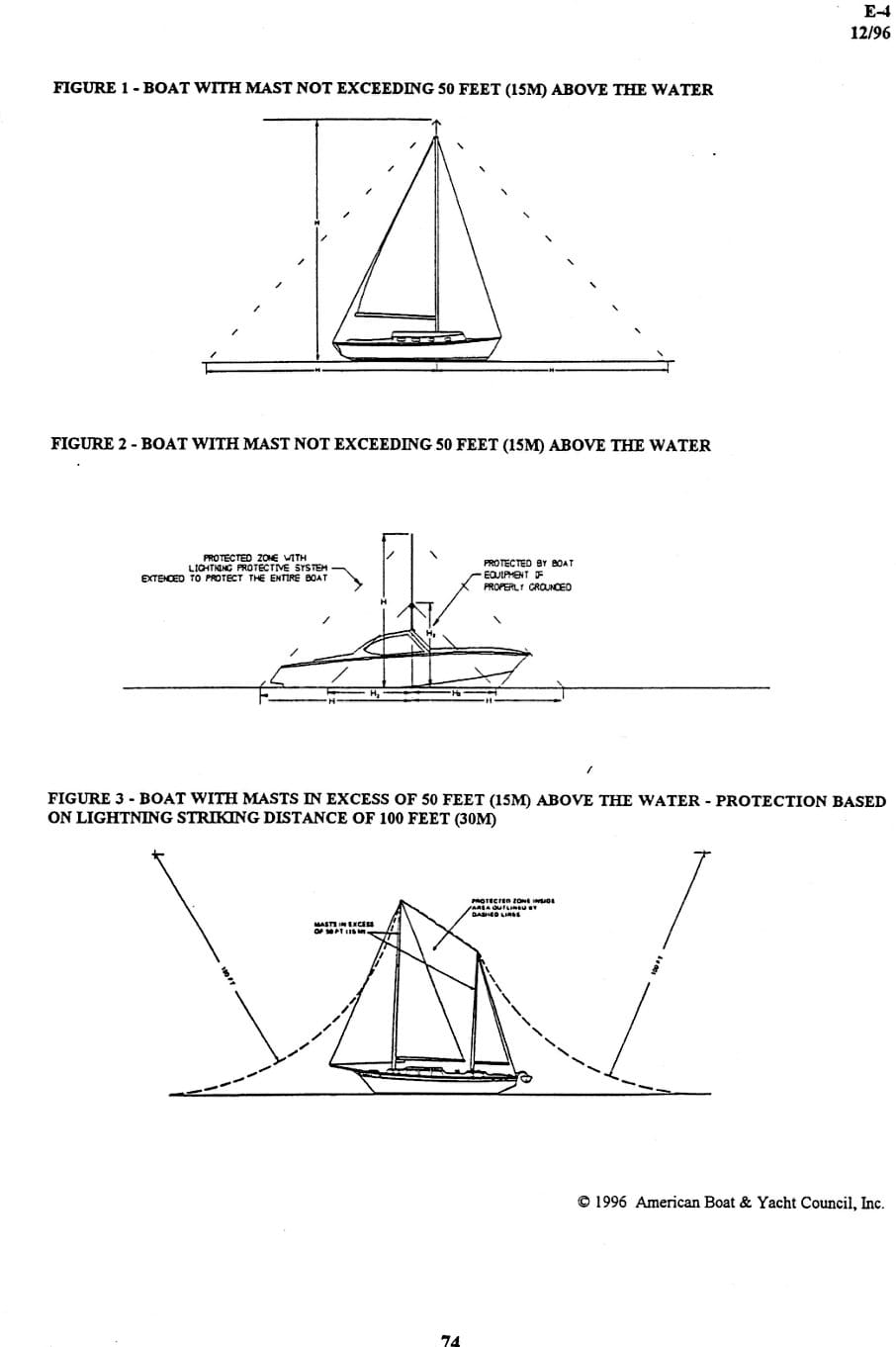
4.8.1 The lightning protective mast shall be located so that the cone of protection will cover the entire boat. See Figure 1 and Figure 2.
4.8.2 Additional lightning protective means shall be erected to form overlapping zones of protection, to protect a boat of the size that renders the use of a single mast impracticable.
NOTE: The zone of protection afforded by any configuration of masts, or other elevated, conductive, grounded objects, can readily be determined graphically. Increasing the height of a mast above the striking distance will not increase the zone of protection.
4.8.3 Lightning Protective Mast Alternatives
- 4.8.3.1 If the mast is composed of non-metallic material, the associated lightning or grounding conductor shall
- 4.8.3.1.1 be essentially straight, and
- 4.8.3.1.2 be securely fastened to the mast, and
- 4.8.3.1.3 extend at least six inches (150mm) above the mast, and
- 4.8.3.1.4 terminate in an air terminal, and
- 4.8.3.1.5 be led as directly as practicable to the grounding connection. See E-4.5.1.
NOTE: Although partially conductive, carbon fiber materials are regarded as non-conductive (non-metallic) for the purpose of this standard.
- 4.8.3.2 An outrigger that serves as a lightning protective mast shall have conductivity equivalent to #4 AWG (21.2mm2) copper.
4.9 Lightning Ground
4.9.1 Primary and Secondary Lightning Ground - A lightning ground for a boat shall consist of any metal surface which is submerged in the water having an area of at least 1 square foot (0.1 m2) and consist of at least one of the following methods.
- 4.9.1.1 External Ground Plate or Equivalent - The external ground plate shall be located as close to the base of the primary conductor as possible to minimize any horizontal runs in the primary conductor.
NOTE: The boat's rudders, struts, external ballast keel, or other external metallic surfaces may provide an external ground plate equivalent.
- 4.9.1.1.1 If the rudder(s) is used as an external ground plate equivalent, the lightning conductor shall be connected directly to the rudder shaft.
- 4.9.1.2 Grounding strip - An external grounding strip of copper, copper alloy, stainless steel, or aluminum, shall be installed under water to be used as an earth ground connection for the lightning system. This strip shall have a minimum thickness of 3/16 inch (5mm), and a minimum width of 3/4 inch (19mm).
NOTES:
- The edges of the external ground plate or grounding strip need to be sharp, exposed, and not caulked or faired into the adjoining area.
- A strip approximately one inch (250mm) wide, and 12 feet (3.7m) long, has nearly six times the amount of edge area exposed to the water, which, compared to the ground plates, will improve the dissipation of charges.
- 4.9.1.2.1 The grounding strip, if used, shall extend from a point directly below the lightning protection mast, towards the aft end of the boat, where a direct connection can be made to the boat's engine.
NOTES: 1. The use of two thru-bolts at each end of the strip will help to prevent the strip from twisting. 2. An equalization bus on the inside of the boat, paralleling the grounding strip on the outside of the boat, may be used as the lightning ground conductor.
4.9.2 Seacocks and Thru-Hull Fittings - Seacocks and thru-hull fittings, if connected to the lightning ground system, shall not be connected to the main down conductor. They shall be connected to
- 4.9.2.1 the underwater grounding strip, or
- 4.9.2.2 the lightning ground plate, or
- 4.9.2.3 the internal equalization bus.
4.9.3 Multihull boats shall provide a lightning ground connection in accordance with 4.9.1 for each hull that has items to be grounded, attached, or fitted to it.
4.10 Requirements - Vessels with Metal Hulls
4.10.1 If there is electrical continuity between metal hulls and masts, or other metallic superstructures of adequate height in accordance with E-4.8, then no further protection against lightning is necessary.
4.11 Requirements - Small Boats
4.11.1 Small boats without a permanent mast shall be protected by means of a temporary lightning protective mast that may be erected when lightning conditions are observed.
- 4.11.1.1 The base of the temporary lightning protective mast shall be located as close to the geometric center of the boat as possible, but, if necessary, can be offset, providing the cone of protection will cover the entire boat when the mast is plugged in.
- 4.11.1.2 The location of the mast base shall be such that persons on the boat can avoid physical contact with the mast or the base.
- 4.11.1.3 The base should extend as high as possible, and provision shall be made to plug in the upper section of the lightning mast so that it will not be displaced by the rolling and pitching of the boat in rough water.
- 4.11.1.4 The temporary lightning protective mast shall be all metal, or other material if provided with a conductor, with a conductivity at least equal to a #4 AWG (21.2mm2) conductor.
NOTE: A solid stainless steel whip antenna or equivalent, that has a conductivity less than a #4 AWG (21.2mm2) conductor, may be used, because of its higher melting temperature, but it will not provide as low a resistance path for the lightning.
- 4.11.1.5 The temporary lightning protective mast shall be connected to a submerged ground plate of at least one square foot (0.1 m2) in area.
4.11.2 Open Daysailers - As stainless steel rigging may not provide an adequate conductive path for the discharge of lightning currents, protection will depend on the grounding of all rigging as well as the metal masts, or the continuous metallic tracks on nonmetallic masts. These shall be connected at the lower ends to a lightning grounding plate, or a lightning grounding strip located directly below the mast.
- 4.11.2.1 Metallic rudders at the aft end of the boat shall not be used as the lightning ground for the mast because of the need for a long horizontal conductor to the aft end of the boat.
- 4.11.2.2 The tiller, or other connections to metallic rudders that the operator will contact, shall be non-conductive materials.
- 4.11.2.3 Metallic keels or centerboards shall be directly connected to the lightning grounding plate or strip, and may serve as the lightning grounding means if they have the required one square foot (0.1 m2) area in contact with the water. If a centerboard is used as the lightning grounding means, a warning sign shall be provided that clearly states that the centerboard must be in the down position to function as a lightning ground.
Appendix - Lightning Protection
This appendix contains additional descriptive information and recommendations pertaining to system maintenance and behavior of personnel.
Ap.1 Zone of Protection - A grounded conductor, or lightning protective mast, will generally divert to itself a direct strike that might otherwise fall within a cone-shaped space, the apex of which is the top of the conductor of a lightning protective mast, and the base of a circle at the surface of the water having a radius that is related to the height of the top of the conductor or lightning protective mast.
Ap.1.2 Boats with ungrounded or non-conductive objects projecting above the metal masts or superstructure may have these objects protected by a lightning ground conductor terminating in an air terminal above the object.
Ap.1.3 Whip type radio antennas should not be tied down during a lightning storm if they have been designed as a part of the lightning protection system.
Ap.2 Maintenance - Lightning protection provisions are likely to receive scant attention after installation. Therefore, their composition and assembly should be strong, and materials used should be highly resistant to corrosion.
- Ap.2.1 Grounding of metallic objects for lightning protection may increase the possibility of harmful galvanic corrosion. See ABYC E-2, Cathodic Protection of Boats.
- Ap.2.2 If a boat has been struck by lightning, compasses, electrical, and electronic gear should be checked to determine whether damage or changes in calibration have taken place.
- Ap.2.3 If a boat has been struck by lightning, the lightning protection system should be inspected for physical damage, system integrity, and continuity to ground.
- Ap.2.4 If a boat has been struck by lightning, it should be hauled for inspection of the hull, underwater structures and thru-hull fittings. Lightning can exit from one or numerous locations below the waterline. Subsequent flooding, sinking, or long term hull damage can result from undetected lightning damage.
Ap.3 Precautions for Personnel - The basic purpose of protection against lightning is to ensure the safety of personnel. It is therefore appropriate that during a lightning storm the following precautions be taken:
- Ap.3.1 Personnel should remain inside a closed boat, as far as practical.
- Ap.3.2 Arms and legs should NOT be dangled in the water.
- Ap.3.3 Consistent with safe handling and navigation of the boat, personnel should avoid making contact with any items connected to a lightning protection system, and especially in such a way as to form a bridge between these items. For example, it is undesirable that an operator be in contact with reversing gear levers and a spotlight control handle at the same time.
- Ap.3.4 Personnel should NOT be in the water.
- Ap.3.5 Personnel should avoid contact with metal parts of a sailboat's rigging, spars, fittings, and railings.
Ap.4 For mast heights in excess of 50 feet (15m), the zone of protection is based on the striking distance of the lightning stroke. Since the lightning stroke may strike any object within the striking distance of the point from which final breakdown to earth ground (the water) occurs, the zone of protection is defined by a circular arc, concave upward. See Figure 2. The radius of the arc is the striking distance, and the arc passes through the tip of the mast, and is tangent to the water. Where more than one mast is used, the arc passes through the tips of adjacent masts. See Figure 3.
The striking distance is related to the peak stroke current, and thus to the severity of the lightning stroke. The greater the severity of the stroke, the greater the striking distance. In the vast majority of cases, the striking distance exceeds 100 feet (30m). Accordingly, the zone based on a striking distance of 100 feet (30m) is considered to be adequately protected.
The zone of protection afforded by any configuration of masts, or other elevated conductive grounded objects, can readily be determined graphically. Increasing the height of a mast above the striking distance will not increase the zone of protection.
Ap.5 Materials
- Ap.5.1 The materials used in the lightning protection system should be resistant to corrosion. The use of combinations of metals that form detrimental galvanic couples should be avoided.
- Ap.5.2 In those cases where it is impractical to avoid a junction of dissimilar metals, the corrosion effect can be reduced by the use of suitable plating or special connectors, such as stainless steel connectors used between aluminum and copper alloys. Except for the use of conducting materials that are part of the structure of the boat, such as aluminum masts, only copper should be used as a lightning conductor system. Where copper is used, it should be of the grade ordinarily required for commercial electrical work, generally designated as being of 95 percent conductivity when annealed.
Ap.6 External Ground Plate - An exterior grounding plate of copper, copper alloys, stainless steel or aluminum may be provided by means of a plate which has an area of at least one square foot (0.1 m2) area. The plate should be located as nearly as possible directly below the lightning protection mast. The boat's propeller(s), shaft(s), metallic rudder(s), and other metallic surfaces that have the required area, can be effectively used on small boats only where the lightning protective mast is located at the stern, above the in-water metallic objects to be used as the lightning system ground. The stern mast must be tall enough to provide a cone of protection that extends to the bow of the boat.
- Ap.6.1 Boats that use a lightning grounding plate instead of the lightning grounding strip should ground backstays, or other objects aft, to the engine negative terminal, a metallic rudder, or other external ground at the aft end of the boat. The lightning ground shall not be routed through the boat to the lightning grounding plate forward under the lightning mast.
Ap.7 Grounding Strip - An external grounding strip of copper, copper alloys, stainless steel, or aluminum, installed under the boat in a fore and aft direction, may be used as the earth ground connection for the lightning system. Except for stainless steel, the strip should have a minimum thickness of 3/16 inch (4.8mm), and a minimum width of 3/4 inch (20mm). Stainless steel should have a minimum thickness of 1/8 inch (3.2mm). The length of the strip should extend from a point directly below the lightning protection mast, to the aft end of the boat, where a direct connection can be made to the boat's engine, but the total length of the strip shall not be less than four feet (1.22m). In a sailing vessel, the backstay and engine should be connected to the aft end of the strip. The strip should be secured to the hull with one, or preferably two, galvanically compatible through bolts at each end. The use of two bolts at each end, spaced one or two inches apart, will help prevent any tendency for the strip to rotate when the electrical connections are made inside the hull. The strip must be located so that the external strip is submerged under all operating conditions. If the strip is not located so as to be submerged when a sailboat is heeled to port or starboard, then a strip will be required on both the port and starboard sides. All connections to the strip should be as short and direct as possible. Additional thru-hull bolts may be located along the length of the strip for additional connections, such as on a two masted sailboat. Because of the possibility of stray current corrosion of the securing bolts, the number of thru-hull bolts should be kept to a minimum. To minimize the number of thru-hull bolt connections, an equalization bus can be installed.
- Ap.7.1 The aft end of the lightning grounding strip should be connected directly to the engine negative terminal. This will provide a path inside the hull for any DC stray currents that might be imposed on the thru-hull bolts that attach the lightning grounding strip where those bolts contact bilge water.
Ap.8 Protection of Equipment - Wherever possible, electronic equipment should be enclosed in metal cabinets that are connected to the lightning grounding system with a minimum #8 AWG (8.39mm2) conductor. Surge suppression devices should be installed on all wiring entering or leaving electronic equipment.
- Ap.8.1 The grounding of metal rod type radio antennas provides some protection for boats without masts and spars provided that
- Ap.8.1.1 conductors in the grounding circuit of the antenna have a conductivity equivalent to #4 AWG (21.2mm2) copper in accordance with E-4.5, and
- Ap.8.1.2 the top of the antenna is not more than 50 feet (15m) above the water, and
- Ap.8.1.3 a line drawn from the top of the antenna downward toward the water at an angle of 45 degrees to the vertical does not intercept any part of the boat (see E-4.8), and
- Ap.8.1.4 the antenna loading coil is provided with a suitable protective device for bypassing the lightning current.
NOTES: 1. Because a loading coil presents a high impedance to the flow of lightning current, the portion of an antenna above the bottom of a loading coil is not as effective as a lightning protective mast. 2. Non-conducting antenna masts with spiral wrapped conductors are not considered suitable for lightning protection purposes.
- Ap.8.2 In order to protect the radio transmitter, antenna feed lines shall be
- Ap.8.2.1 equipped with a means for grounding during electrical storms, or
- Ap.8.2.2 protected by lightning arresters or lightning protective gaps.
The final page of the ABYC extract (original page 78) is a notice, mostly illegible in the scan, about the status of ABYC standards and recommended practices.